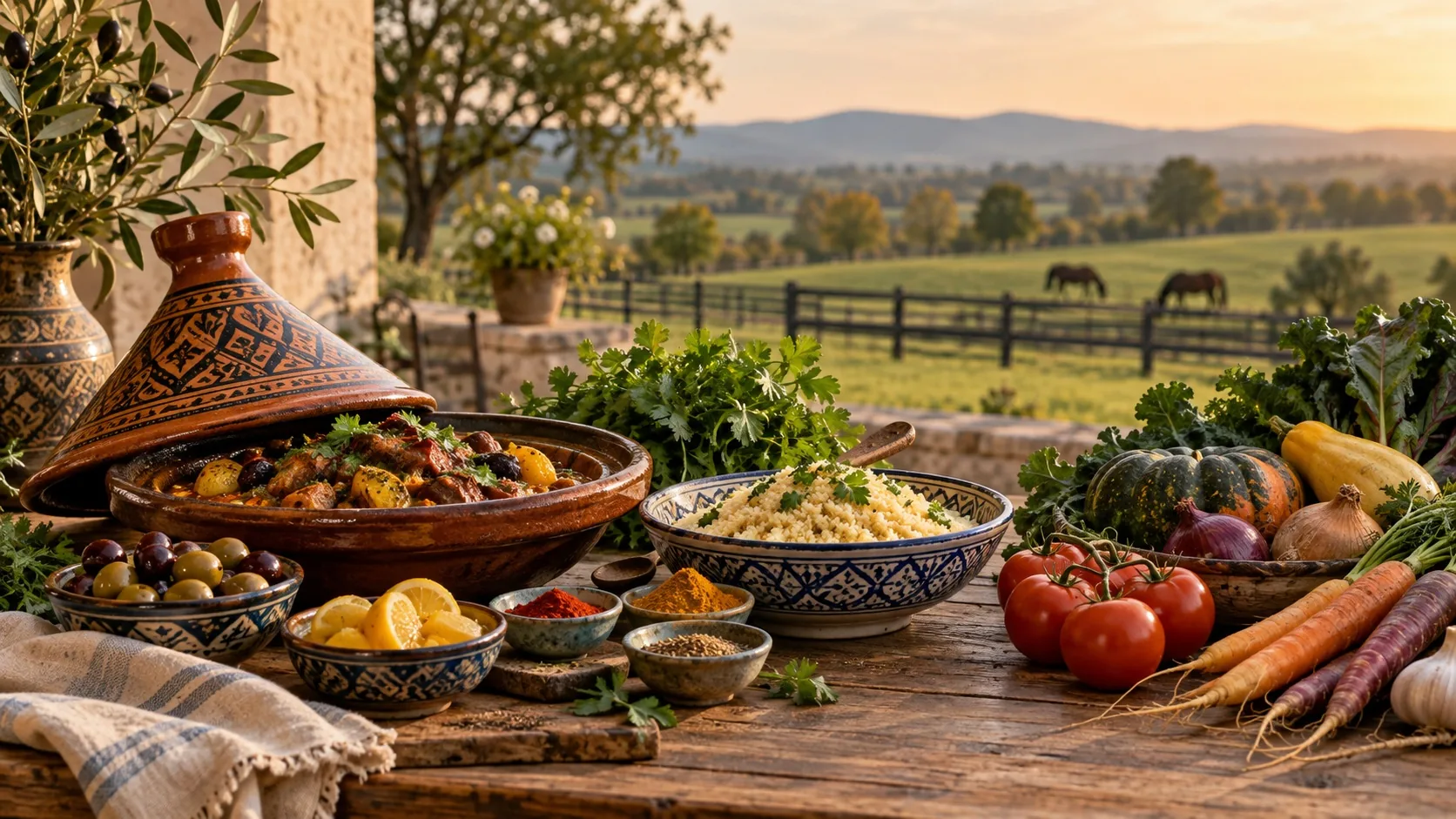
Moroccan cooking begins long before the spices go into the pot.
It begins with the ingredients.
The quality of a tomato. The freshness of the herbs. The sweetness of an onion. The tenderness of a piece of lamb. The ripeness of fruit. The difference between an ingredient that is simply available and one that is truly good.
That attention to ingredients is deeply familiar to Oumi.
She grew up in northern Morocco in a farming family, surrounded by vegetables, fruit, herbs and fresh products from the land around her. From an early age, she learned to judge ingredients with her eyes, hands and senses — a habit that stayed with her throughout her life.
Today, in Lexington, that same instinct finds a new landscape.
Central Kentucky has its own agricultural identity, its own seasons, and its own excellent local products. For Oumi's Legacy, that creates an interesting possibility: bringing Moroccan cooking techniques and traditions together with ingredients grown and produced close to home.
Not to turn Moroccan food into fusion. But to let good local ingredients support it.
Discover generous Moroccan dishes through Oumi's Flavors.
Moroccan cooking has always been connected to place
Moroccan cuisine is remarkably diverse because Morocco itself is diverse.
Coastal regions developed differently from mountain areas. Agricultural plains produced different dishes from desert communities. Families cooked with what grew well around them, while spices, preserved ingredients and trade connected those local foods to a wider culinary tradition.
That means adapting to place is not foreign to Moroccan cooking.
It is part of its history.
The important question is not whether an ingredient comes from Morocco.
The question is whether it respects the character of the dish.
Lexington offers more than a new address
Lexington and the surrounding region are closely connected to agriculture.
Local markets and farms bring seasonal vegetables, herbs, meat, fruit, honey and other products directly into the city. For a cuisine that depends so heavily on freshness and ingredient quality, that matters.
A Moroccan cook does not need every ingredient to travel thousands of miles.
Many of the foundations of Moroccan cooking are already familiar here: Tomatoes, Onions, Carrots, Squash, Fresh herbs, Apples, Pears, Chicken, Beef, Lamb, Honey.
Good vegetables and good meat do not need to become "Moroccan."
They need to be treated with Moroccan technique.
Local vegetables, Moroccan methods
Consider couscous.
The identity of couscous does not depend on one exact combination of vegetables. Families and regions prepare it differently. What matters is the structure of the dish, the seasoning, the broth, the treatment of the semolina, and the generosity of the final plate.
Fresh local carrots, squash, turnips or seasonal greens can therefore fit naturally into a couscous without changing what the dish is.
The same is true of tagines.
A tagine is not defined by importing every ingredient from Morocco. It is defined by the way flavors are built slowly, the balance of spice and acidity, the use of herbs, preserved ingredients and careful cooking.
A locally raised chicken can become a chicken tagine with preserved lemon and olives.
Kentucky lamb can be slow-cooked with prunes, almonds and warm spices.
Local tomatoes can become the base for kefta.
Fresh herbs can brighten salads, marinades and sauces.
The ingredient may be local.
The cooking remains Moroccan.
Authenticity does not mean refusing to adapt
What matters is understanding the identity of the dish well enough to know what can adapt without losing it.
That is what Oumi experienced when she moved to the United States.
A new country meant different products and different suppliers, but the principles remained the same: select carefully, cook patiently, respect the dish, and do not take shortcuts that erase its character.
From one agricultural tradition to another
There is something fitting about Moroccan cooking taking root in Lexington.
Oumi grew up close to agriculture.
Lexington is a city surrounded by it.
The landscapes are different. The ingredients are not identical. The culinary traditions have their own histories.
But there is a shared respect for food that begins with the land.
That creates a natural meeting point.
For Oumi's Legacy, the goal is to cook Moroccan food with the best ingredients available here, while preserving the techniques, flavors and hospitality that give it its identity.
That is the kind of adaptation that keeps a cuisine alive.
Rooted in Morocco.
Cooked in Lexington.
And made to be shared.
There could be no better place for Oumi’s cuisine to take root and for the Oumi’s Legacy journey to begin.


