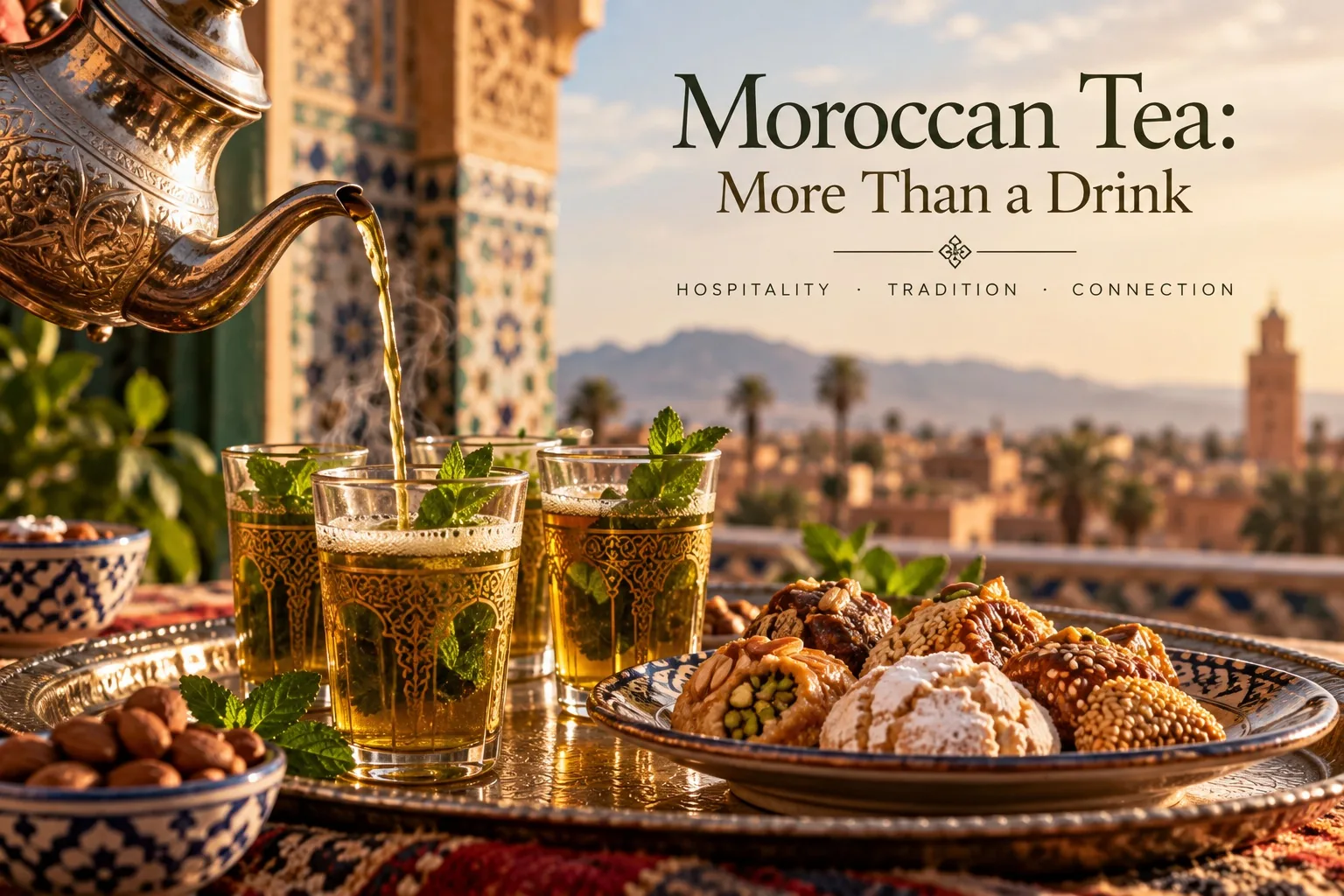
In Morocco, tea is rarely just tea. It is one of the first things offered to a guest, one of the last things shared before people leave, and something that can turn an ordinary moment into a reason to sit together a little longer.
A tray appears.
Glasses are arranged.
Fresh mint releases its scent before the first pour.
And for a few minutes, everything slows down.
That is part of what makes Moroccan tea so special. It is not only a drink. It is a gesture of welcome.
Discover the traditions firsthand in Oumi's Atelier: Moroccan Tea & Hospitality.
A ritual of hospitality
Moroccan mint tea is deeply connected to hospitality.
When someone enters a home, offering tea is almost instinctive. It says: sit, stay, you are welcome here.
The tea may be served with pastries, nuts, bread, or something sweet, but even on its own, the act of preparing and serving it carries meaning.
The host does not simply hand over a cup.
The tea is prepared, poured, tasted, adjusted, and served with care.
The gesture matters as much as the drink itself.
The pleasure is in the preparation
Moroccan tea is usually built around green tea, fresh mint, hot water, and sugar, but the final cup depends heavily on how it is prepared.
Every family has its habits.
Some prefer the tea stronger.
Some use more mint.
Some make it very sweet.
Others adjust the balance depending on the season, the guests, or the occasion.
And then there is the pour.
Tea is often poured from a height into small glasses, creating a light foam at the top. It is practical, theatrical, and unmistakably part of the experience.
The sound of the tea hitting the glass is almost part of the ritual.
Tea and pastries belong naturally together
For many Moroccan families, mint tea and pastries are inseparable.
Before celebrations, families often prepare large quantities of pastries not only for the holiday itself, but so the house remains ready for visitors afterward.
When someone comes by, the good serving dishes come out.
Tea is prepared.
Pastries are arranged.
The guest is given the best place available.
The message is not spoken, but it is clear:
You are not an interruption.
You are being received.
That is why Moroccan pastries are more than desserts, just as tea is more than a drink.
Together, they form part of the language of hospitality.
A small glass with a big role
Moroccan tea has a remarkable ability to fit almost any moment.
It can follow a large family meal.
It can accompany a quiet conversation.
It can welcome someone you know well or someone entering your home for the first time.
It can be part of a celebration or part of an ordinary afternoon.
The ingredients are simple.
The role is not.
Tea can signal welcome, generosity, friendship, respect, and care.
More than refreshment
It is easy to describe Moroccan mint tea as sweet green tea with fresh mint.
Technically, that is true.
But it misses the most important part.
What makes Moroccan tea special is the experience around it.
The tray.
The glasses.
The fragrance.
The pouring.
The pastries beside it.
The conversation that follows.
The decision to stop what you are doing and make someone feel welcome.
That is why Moroccan tea is more than a drink.
It is hospitality in a glass.

