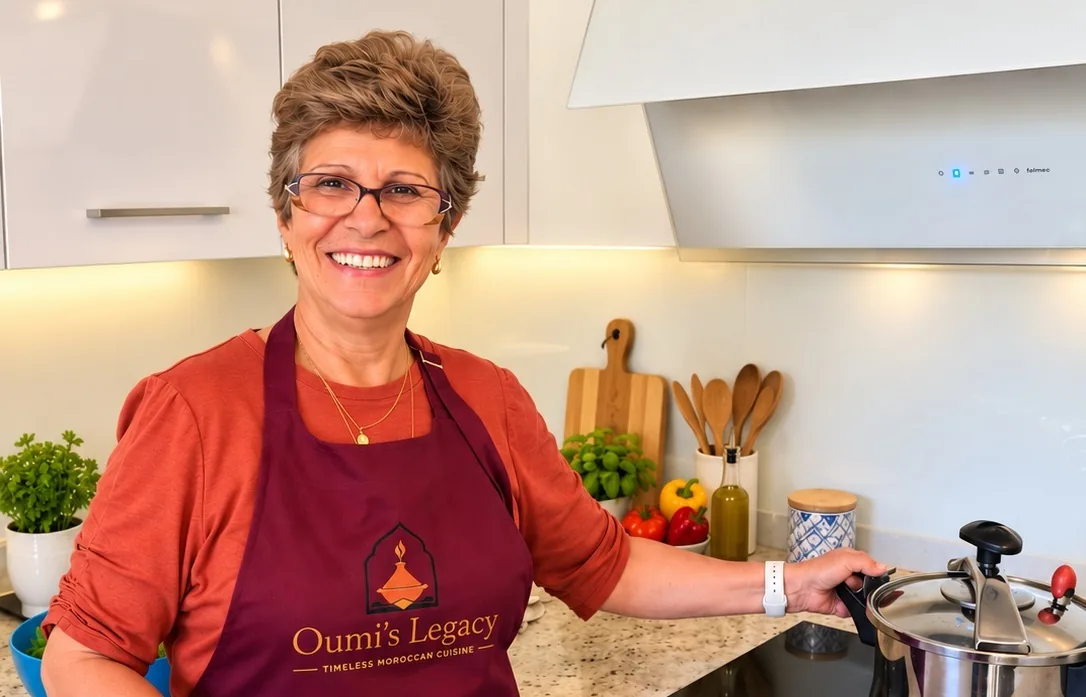
But they will also tell you how it made them feel: welcomed, cared for, unhurried.
That is Oumi’s real gift. The food matters deeply, but so does the way it brings people in.
“Oumi” is the Arabic word for “mom”. In our family, it became more than that. It became a name, a role, and eventually the starting point for something we wanted to preserve.
She was born and raised in northern Morocco, in a farming family, surrounded by orchards, vegetables, fruit and ingredients that came directly from the land around her. Long before she learned to think about food in terms of recipes, she learned to look closely at ingredients — to notice freshness, ripeness, texture and quality.
That connection to the land stayed with her. Even today, part of Oumi’s instinct in the kitchen begins before the cooking starts: choosing the right tomato, the right herbs, the right piece of fruit, the ingredient that will truly carry the dish.
At home, cooking was learned by watching, repeating, tasting and remembering. Her mother taught her without written instructions or exact measurements. She learned by standing beside her, noticing the texture of a dough, the smell of a sauce and the moment something had cooked long enough.
Oumi started early
By the age of thirteen, as the eldest daughter, she was already helping her mother prepare weekend meals for more than twenty people — the family, farm workers and shepherds who worked the land.
They ate the same food, together, at the same table.
For Oumi, hospitality was never something formal or staged. It was simply part of how people lived: if you cooked, you cooked for everyone. If people were working beside you, they were fed beside you too.
That kind of cooking taught her more than technique. It taught her how to prepare generously, how to think ahead, how to manage quantity without losing quality, and how food could create a sense of belonging among very different people.
Some of our strongest family memories grew out of that same spirit.
Before every celebration, our home would fill with activity. Oumi and other mothers would gather together to prepare large quantities of Moroccan pastries. They worked side by side for hours, and when everything was finished, the pastries were divided equally among the women to take back to their homes.
The pastries were not made only for the celebration day.
They were meant to last — ready for relatives, friends, neighbors, or anyone who might come through the door in the days and weeks that followed.
In our home, it was almost unthinkable for someone to visit without being offered mint tea and pastries. And not casually. The best dishes would come out. The guest would be seated in the best place in the house. Whatever else was happening could wait.
That was part of the lesson too: hospitality was not reserved for special occasions. You stayed ready for people.
The pastries waiting in the house were more than sweets. They were a quiet sign that the home was prepared to welcome someone at any moment.
After finishing her studies in Rabat, Oumi moved several times for work. Each place added something to what she knew. Moroccan cooking changes from region to region, shaped by local ingredients, family habits and traditions passed from one generation to the next. She paid attention to those differences and learned not only how dishes were made, but why people made them the way they did.
Over time, cooking became one of the clearest ways she cared for people.
By the time she had three children of her own, the kitchen had become the center of family life: Friday couscous, pastries prepared because guests might come, long meals, full plates, and the familiar instruction to sit down and eat before worrying about anything else.
Then came a much bigger move: the United States.
A new country meant a new kitchen, different ingredients and a different rhythm of life. Oumi adapted, but she did not lose the character of the food she knew. She kept the techniques, patience and attention she had learned in Morocco, while finding her way in a new place.
Soon, she was cooking for friends who had never tasted msemen, who did not know what to expect from a tagine, and who quickly understood why meals at her table lasted a little longer than planned.
Her three children grew up watching all of this. They learned recipes, certainly, but that was never the most important lesson.
They inherited a way of treating people.
Hospitality meant noticing who needed more on their plate. It meant preparing enough because someone might come by. It meant giving time, attention and care without making a show of it.
That is what led to Oumi’s Legacy.
It is a family business built by Oumi and the three children she raised around that table. It is a continuation of what already existed inside one home: Moroccan cooking, family traditions and a way of welcoming people that deserved to be preserved and shared more widely.
Oumi’s Legacy also honors something familiar in many Moroccan homes: knowledge passed down by observation, instinct and repetition; recipes remembered through the hands as much as through words; and hospitality understood not as performance, but as practice.
That is why the name matters.
This is not only about preserving dishes. It is about preserving what sits behind them — the care, the memory, the standards, the generosity, and the way food creates connection.
Oumi taught her children how to cook.
More importantly, she taught them why.
Now they are carrying that forward together, so that more people, wherever they are from, can pull up a chair and experience a little of what it means to be at Oumi’s table.
More than recipes. A legacy.


