Moroccan pastries are often admired for their beauty first.
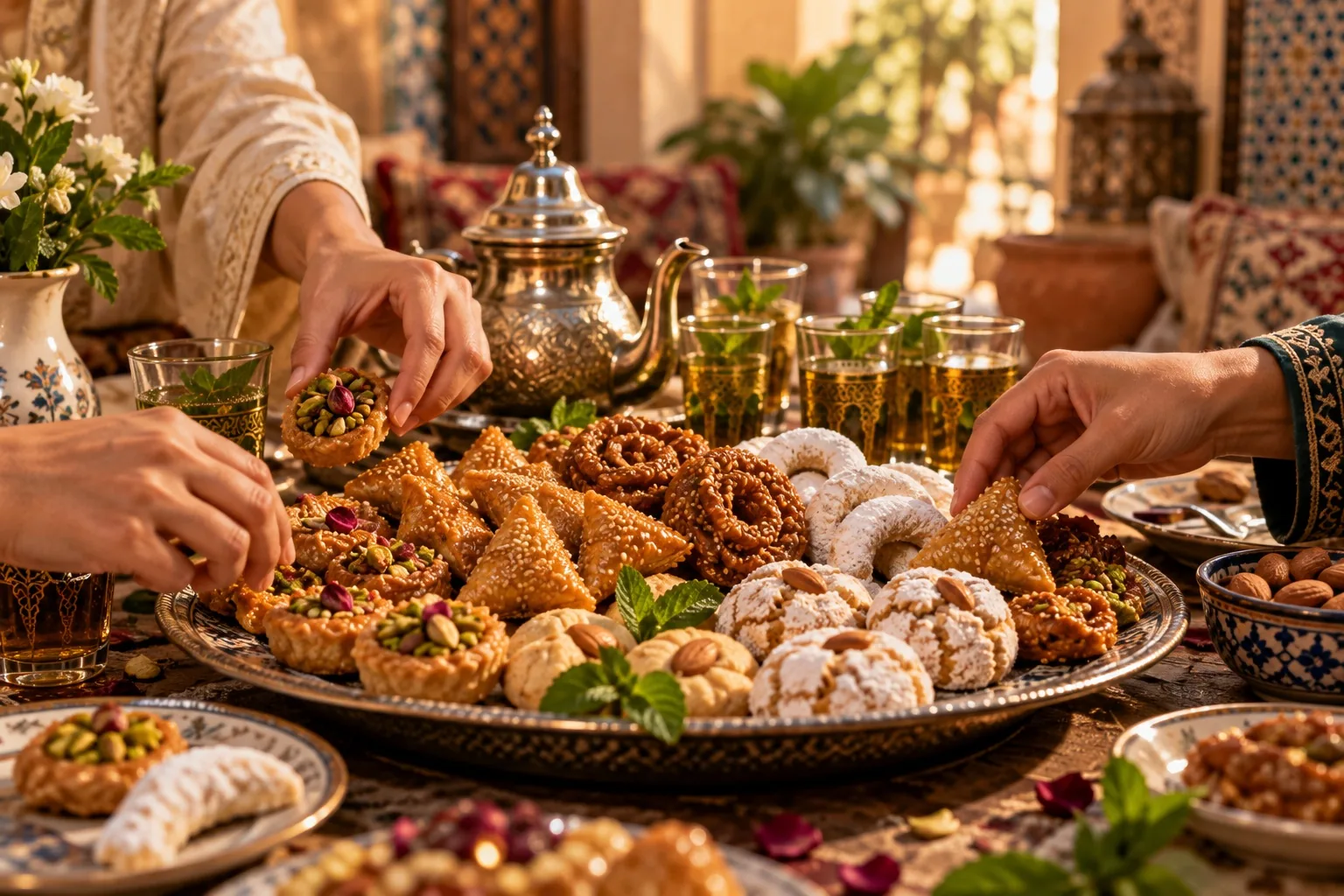
The delicate crescent of a corne de gazelle. The shine of honey on a briouate. The sesame on a chebakia. The careful shape of an almond-filled pastry arranged on a serving plate.
But Moroccan pastries were never really meant to be admired from a distance.
They were made to be shared.
That is what gives them a meaning beyond sweetness.
Explore Oumi's handcrafted pastries through Oumi's Delights.
Pastries belong to the moment around them
In many Moroccan homes, pastries are not reserved only for dessert.
They appear with mint tea when guests arrive.
They are prepared for celebrations, weddings and family visits.
They sit on the table during long conversations.
And often, they are kept ready in the house so that hospitality does not have to be planned in advance.
Someone comes by, and the pastries come out.
That simple habit says a great deal about Moroccan hospitality.
You do not wait for a formal occasion to receive someone properly.
You stay ready.
The preparation itself can be communal
Some of the strongest traditions around Moroccan pastries begin before anyone eats them.
In many families, women gather before major celebrations to prepare large quantities together. Dough is mixed, almonds are ground, fillings are shaped, trays move in and out of the oven, and everyone contributes.
The work is shared.
So is the result.
In our own family, before a celebration, Oumi and other mothers would gather in our home to prepare pastries together. At the end, everything was divided equally among them.
Each woman returned home with an assortment ready for her own family and guests.
That memory captures something important: the pastries were already creating connection before they ever reached the table.
They are designed for abundance
Many Moroccan pastries are small by design.
That matters.
A guest is not presented with one large dessert and expected to finish it.
Instead, a plate arrives with different shapes, textures and flavors.
You take one.
Then perhaps another.
The format encourages sharing naturally.
It also allows variety.
One pastry may be delicate and almond-forward.
Another may be crisp and coated in honey.
Another may carry sesame, orange blossom or warm spice.
Together, the plate becomes part of the conversation.
Tea and pastries complete each other
Moroccan pastries are especially closely tied to tea.
Mint tea brings freshness and warmth.
Pastries bring texture, sweetness and aroma.
Together, they create a rhythm.
Pour.
Taste.
Talk.
Refill.
Offer another piece.
That is why the experience feels so different from simply eating a sweet snack.
The pastries are part of a social ritual.
The best dishes come out
Hospitality in Morocco is often expressed through presentation as much as quantity.
When guests arrive, the good dishes come out.
The best tray.
The nicest glasses.
The pastries arranged properly.
The effort communicates respect.
The message is simple:
You are worth preparing for.
That is why Moroccan pastries are often beautiful, even when they are made in large quantities.
Their appearance is part of the welcome.
They are made to last
Another reason Moroccan pastries are so suited to hospitality is practical.
Many traditional varieties are made to keep well.
That means they can be prepared ahead of a celebration and remain available afterward for the steady flow of guests who may visit over several days.
This matters culturally.
Hospitality should not depend on whether someone announced their visit three days in advance.
The house should still be able to receive them well.
A tray of pastries waiting in the cupboard helps make that possible.
Sharing changes the meaning of sweetness
A pastry eaten alone can be delicious.
A pastry offered to someone becomes something else.
It becomes a gesture.
That is why Moroccan pastries fit so naturally into gatherings.
They are small enough to offer.
Beautiful enough to honor the guest.
Varied enough to invite curiosity.
And familiar enough to carry memory.
They turn sweetness into hospitality.
That is why Moroccan pastries are made for sharing.
Because in Moroccan hospitality, sweetness is not something you keep for yourself. You put it on the table.


