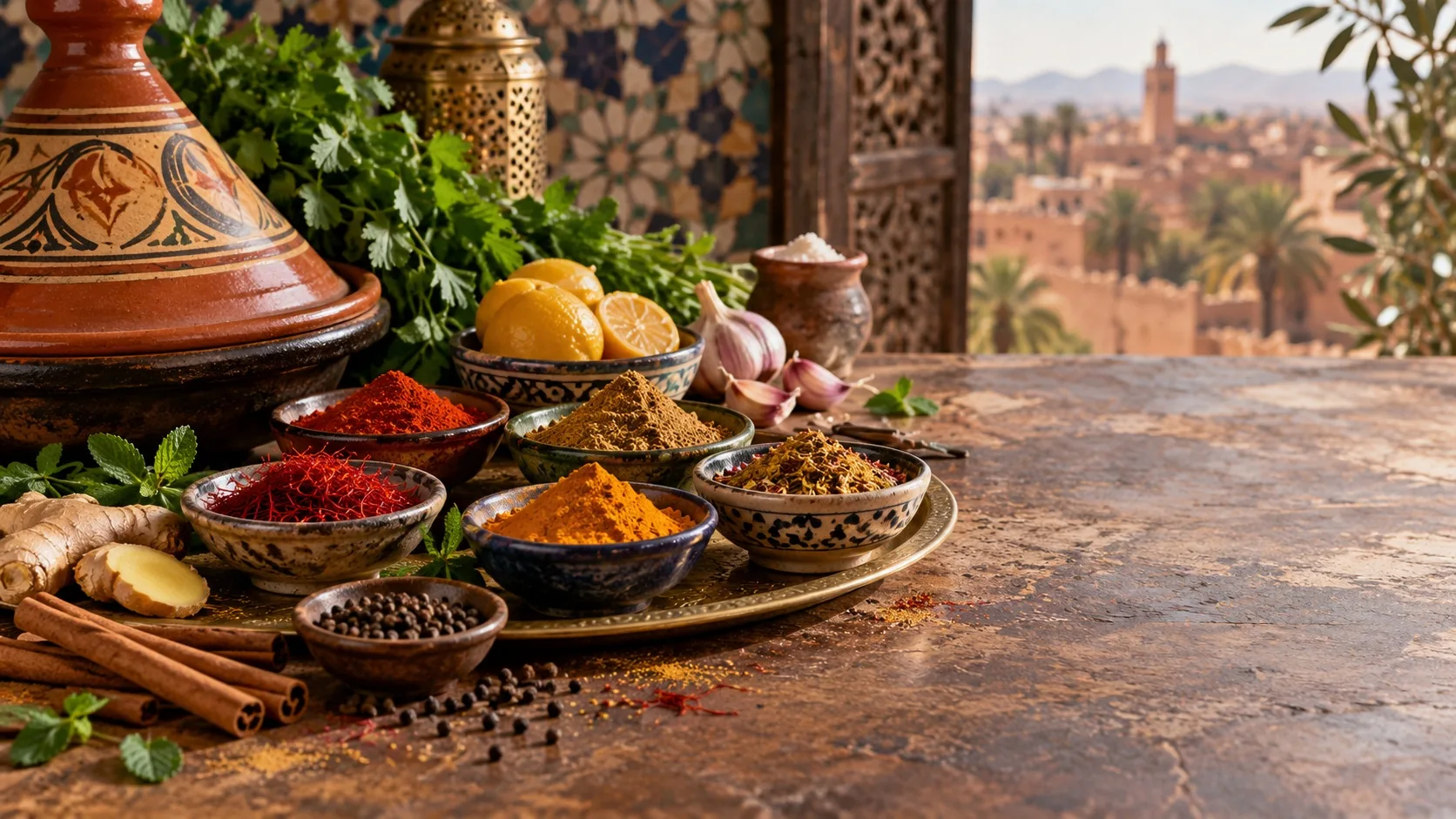
Walk into a Moroccan kitchen and you may notice the spices before anything else.
Warm, earthy, floral, peppery, sometimes sweet — Moroccan cooking is built on layers of aroma. But the role of spices is often misunderstood.
The goal is not simply to make food “spicy.”
It is to create balance.
A good Moroccan dish should not taste like a list of seasonings. The spices should support the ingredients, deepen the sauce, and work together until it becomes difficult to separate one from another.
That is part of the craft.
Cumin: earthy and unmistakable
Cumin is one of the most recognizable flavors in Moroccan cooking.
It is warm, earthy, slightly bitter, and deeply savory. It appears in countless everyday dishes, from grilled meats and kefta to lentils, vegetables and salads.
It is also one of the spices most likely to appear at the table itself, sometimes served alongside salt for diners to add according to taste.
Cumin gives Moroccan food depth without needing heat.
It is especially powerful with tomatoes, legumes, lamb, beef and roasted vegetables.
Ginger: warmth without sweetness
Ground ginger is another cornerstone.
In Moroccan cooking, it is often used in savory dishes rather than desserts. It brings warmth and fragrance to tagines, chicken dishes, sauces and stews.
Its role is subtle.
You may not always identify ginger immediately, but remove it and the dish can suddenly feel flatter.
It often works alongside turmeric, pepper and saffron, helping create the warm aromatic base associated with many Moroccan dishes.
Turmeric: color and quiet depth
Turmeric adds a warm golden color and a gentle earthy bitterness.
It is commonly used in tagines, chicken dishes, vegetables and sauces, often together with ginger.
Its purpose is not to dominate.
It contributes color, warmth and structure.
In a well-balanced dish, turmeric becomes part of the background, supporting other ingredients rather than drawing attention to itself.
Paprika: sweetness, color and warmth
Paprika is widely used in Moroccan savory cooking.
Depending on the preparation, it can bring sweetness, mild warmth, color and body. It is especially common in tomato-based dishes, marinades, kefta and grilled preparations.
It works naturally with cumin, garlic, coriander and olive oil.
Paprika is one of the spices that helps give Moroccan dishes richness without making them excessively hot.
Black pepper: more important than it looks
Black pepper may seem ordinary, but it plays an important role in Moroccan seasoning.
It sharpens.
It lifts.
It adds a dry warmth that helps balance richer ingredients.
Used correctly, it does not make a dish taste “peppery.” It simply gives more definition to the other flavors around it.
Cinnamon: not just for sweets
Cinnamon is one of the spices that most clearly shows how comfortable Moroccan cuisine is with the meeting of sweet and savory.
It appears in pastries and desserts, certainly, but also in meat dishes, pastilla, couscous preparations and tagines with dried fruit.
Its job is not always to make a dish taste sweet.
Often, cinnamon adds warmth, perfume and complexity.
When paired with meat, almonds, prunes or onions, it helps create one of the most distinctive flavor profiles in Moroccan cooking.
Saffron: precious and aromatic
True saffron is used with restraint.
A small amount can bring color, floral aroma and a delicate bitterness that is very different from turmeric.
It is especially valued in refined dishes, chicken preparations, festive cooking and sauces where its fragrance has room to come through.
Because saffron is expensive, quality matters enormously.
A little good saffron is more valuable than a large amount of something inferior.
Coriander: seed and leaf, two different roles
Moroccan cooking uses coriander in more than one form.
Ground coriander seed has a warm, citrusy, slightly nutty flavor and works beautifully in spice blends and savory dishes.
Fresh coriander — cilantro — is something else entirely.
Together with parsley, it forms the fresh green backbone of many Moroccan preparations.
Those herbs bring brightness to dishes that might otherwise feel heavy, especially after long cooking.
In many recipes, the spices provide depth while the herbs bring life.
Ras el hanout: not one fixed recipe
Ras el hanout is one of the best-known Moroccan spice blends, but it is often misunderstood outside Morocco.
It is not a single standardized mixture.
The name roughly refers to the “top of the shop” — a merchant’s prized blend — and its composition can vary significantly.
One version may emphasize warm spices.
Another may be more floral.
Another may be more peppery or aromatic.
That variation is part of its identity.
Ras el hanout is often used in special dishes, meats, couscous or festive preparations where a more complex aromatic profile is wanted.
But Moroccan cooking does not depend on ras el hanout alone.
Many dishes are built from individual spices added deliberately, one by one.
Spice blends are learned through judgment
What matters most in Moroccan cooking is not simply owning the right spices.
It is knowing how to use them.
How much cumin is enough?
When should ginger be added?
Should cinnamon sit in the background or be noticeable?
Does this dish need more warmth, more brightness, or more depth?
Those decisions are often learned through experience rather than exact formulas.
You watch.
You smell.
You taste.
You adjust.
That is why two cooks using the same ingredients can produce very different results.


